
By CandCalc Editorial Team | Published September 22, 2026 | Updated November 15, 2026
Quick AI Summary
Financing a vehicle through a major Canadian chartered bank offers clear interest rate transparency, predictable borrowing terms, and strong pre-approval leverage.
Featured article
How to Get a Car Loan from a Bank in Canada (2026): RBC, TD, BMO & Scotiabank Rates, Approval & Checklist
Financing a vehicle through a major Canadian chartered bank offers clear interest rate transparency, predictable borrowing terms, and strong pre-approval leverage. Understanding how Canada's Big Five banks (RBC, TD, Scotiabank, BMO, CIBC) and regional credit unions underwrite vehicle loans allows you to secure the lowest possible borrowing costs before setting foot in a dealership showroom.
Table of Contents
Quick navigation
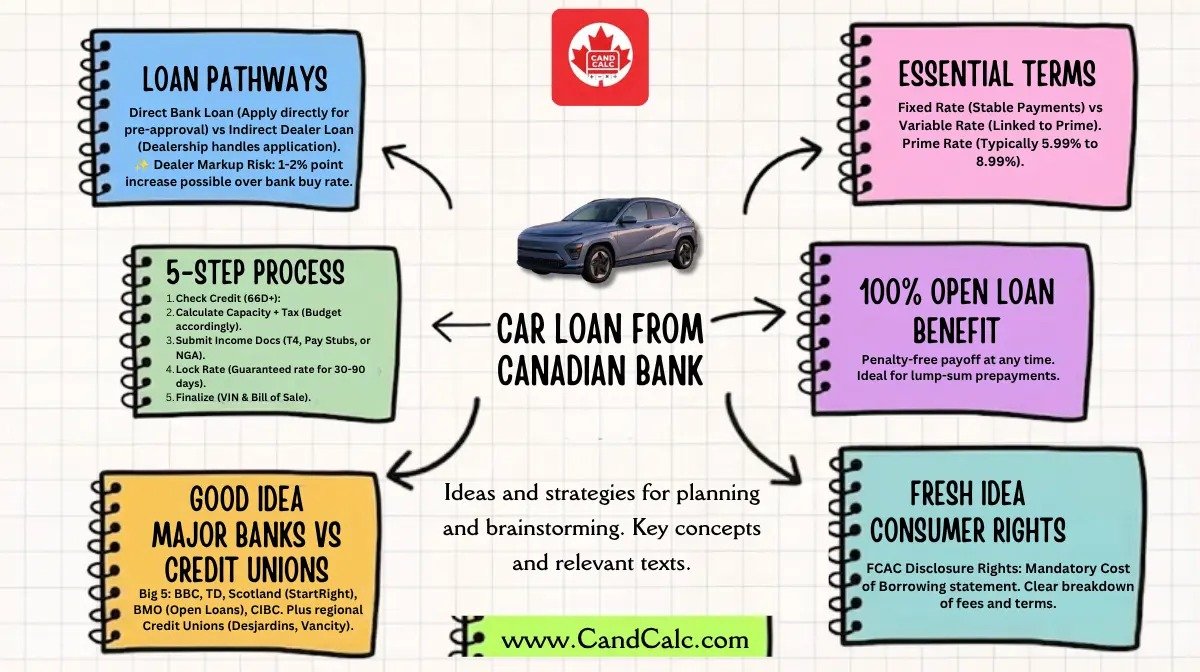
1. Direct Bank Financing vs. Indirect Dealer Financing
When financing a vehicle, Canadians have two distinct banking pathways:
- Direct Bank Loan: You apply directly with your bank (online, over the phone, or at a local branch). The bank approves a set loan amount at a fixed or variable APR. You receive a pre-approval certificate and negotiate with the dealer as a cash buyer.
- Indirect Dealer Financing: The dealership's finance and insurance (F&I) department submits your credit application through an indirect automotive lending network (such as DealerTrack or RouteOne) to multiple financial institutions, including bank auto finance arms (e.g., TD Auto Finance, Scotiabank Automotive, RBC Dealer Finance).
While indirect financing is convenient, dealerships often mark up the bank's wholesale "buy rate" by 1% to 2% to generate dealer reserve profit. Getting a direct pre-approval prevents this markup.
2. Major Canadian Bank Auto Loan Programs
Canada’s primary financial institutions provide dedicated vehicle borrowing solutions:
| Institution | Estimated 2026 APR Range | Loan Features | Typical Amortization | Best For |
|---|---|---|---|---|
| RBC Royal Bank | 6.49% – 8.99% | Fixed and variable rate options, relationship rate discounts. | 12 to 84 months | Existing clients, private sales |
| TD Auto Finance | 6.79% – 9.49% | Largest Canadian dealership lending network, flexible weekly/bi-weekly payments. | 24 to 84 months | Broad credit spectrum, dealership purchases |
| Scotiabank | 6.69% – 9.19% | StartRight Program for Canadian newcomers, pre-approved vehicle loans. | 12 to 84 months | Newcomers, international students |
| BMO (Bank of Montreal) | 6.59% – 8.99% | Fixed rate auto financing, no prepayment penalties, dealer partnerships. | 12 to 84 months | Fixed monthly budgeting, used cars |
| CIBC | 6.74% – 9.29% | Secured and unsecured personal car loans, flexible repayment schedules. | 12 to 84 months | Personal car loans, private sales |
💡 Calculate Your Exact Bank Payment:
Planning a loan through RBC, TD, BMO, or Scotiabank? Estimate your exact monthly and bi-weekly payment including provincial taxes (GST/HST/PST) and fees before applying:
3. Step-by-Step Guide to Applying for a Bank Car Loan
- Review Credit Profile: Verify you meet typical prime banking criteria (score 660+). If your score is building, see our advice on credit scores needed for auto financing.
- Calculate Borrowing Capacity: Use our car loan interest rate calculator to model monthly and bi-weekly payment options at current prime benchmark rates.
- Submit Pre-Approval Application: Provide income verification (T4, pay stubs, or NOA) and state your estimated purchase amount.
- Lock Your Pre-Approved Rate: Bank auto loan pre-approvals typically hold an interest rate for 30 to 90 days, protecting you against rate hikes while vehicle shopping.
- Finalize Purchase: Present your pre-approval letter to the selling dealership or private seller. The bank will issue a draft or direct electronic deposit once the bill of sale and VIN are verified.
4. Bank Auto Loan vs. Personal Line of Credit
Some Canadian borrowers wonder whether an unsecured personal Line of Credit (LOC) or Home Equity Line of Credit (HELOC) is preferable to a dedicated auto loan. While LOCs offer flexible revolving repayments, their interest rates are variable and fluctuate with the Bank of Canada policy rate. For an in-depth financial comparison, review our guide on car loans vs lines of credit.
5. Provincial Tax Integration on Bank Financed Vehicles
When a bank funds your vehicle purchase, they calculate total borrowing needs inclusive of provincial sales taxes (13% HST in Ontario, 14.975% GST/QST in Quebec, 12% in BC, and 5% GST in Alberta). Explore our Ontario car loan tax calculator to see how taxes impact your financed total.
Illustrative Example Notice: Bank interest rate ranges and program details are provided for illustrative and educational purposes. Actual rates, loan amounts, and credit approvals depend on individual financial evaluation by respective chartered institutions.
RECOMMENDED ARTICLES

Lease vs Buy a Car in Canada: Financial Comparison & Guide
What Is GAP Insurance in Canada and Do You Need It?

Car Loan Taxes and Fees in Canada: What You Pay by Province

Trade-In and Car Loan Financing: Tax Savings & Equity Explained
What Is Negative Equity on a Car Loan and How to Deal With It?

How to Pay Off a Car Loan Early Without Penalties in Canada
Canadian Bank vs. Credit Union Financing Comparison
While Canada's Big Five chartered banks (RBC, TD, Scotiabank, BMO, CIBC) dominate prime auto lending, Canadian credit unions and provincial caisses populaires (such as Desjardins in Quebec and Ontario, Meridian in Ontario, or Vancity in British Columbia) offer compelling alternatives. Credit unions are member-owned financial cooperatives that often maintain more flexible lending guidelines for local borrowers, recent immigrants, and self-employed professionals.
When applying for a bank car loan, your application undergoes automated credit scoring via Equifax Canada and TransUnion Canada. Banks typically offer two structures: fixed-rate installment loans with guaranteed payment stability, or variable-rate loans tied to the Bank of Canada prime rate. If you anticipate making lump-sum prepayments, confirm in writing that your loan is fully open and free of prepayment penalty fees.
Provincial Regulatory Rights for Bank Borrowers
Federally regulated financial institutions (Schedule I banks) fall under the oversight of the Financial Consumer Agency of Canada (FCAC). The FCAC enforces mandatory cost-of-borrowing regulations, requiring lenders to provide a clear, standardized disclosure statement before you sign. This statement must itemize the total interest payable over the term, any mandatory administration fees, and your rights regarding optional credit insurance products.
Interactive Bank & Financing Calculators
Compare direct bank financing terms with dealer financing using our interactive calculators:
BMO Auto Loan vs. Other Canadian Banks: Which Bank Is Best?
Bank of Montreal (BMO) is one of Canada's largest auto loan originators, financing tens of thousands of consumer vehicle purchases annually. When evaluating a BMO auto loan against lenders like RBC, TD, and Scotiabank, there are two key avenues to understand:
- BMO Dealer Direct Financing: Most BMO car loans are arranged directly at dealerships via the dealer's finance office (F&I department). Dealerships have direct portal access to BMO Automotive Finance, allowing instant loan approvals, competitive tiered interest rates, and loan terms extending up to 84 or 96 months.
- BMO Branch Direct Auto Loans & Personal Lines of Credit: You can also apply directly at a BMO branch or online for a personal car loan or a Personal Line of Credit. An unsecured or secured line of credit through BMO gives you pre-approved cash-buyer status, letting you negotiate vehicle purchase prices without dealer markup.
Best Canadian Banks for Car Loans: Newcomers & Work Permit Holders
If you have recently immigrated to Canada, have permanent residency (PR), or hold a temporary foreign work permit (with a 9-series SIN), securing an auto loan through a traditional Canadian bank is straightforward if you use dedicated newcomer financing programs:
| Bank & Program | Eligibility (PR / Work Permit) | Minimum Down Payment | Max Vehicle Value / Terms |
|---|---|---|---|
| RBC Newcomer Advantage | Permanent Resident or Work Permit (< 5 yrs in Canada) | 15% - 20% down | Up to $75,000; up to 60-72 months |
| BMO NewStart Auto Program | Permanent Resident & International Workers | 10% - 20% down | Up to $50,000; loan term cannot exceed work permit expiry |
| Scotiabank StartRight | Landed Immigrants, PRs & Foreign Workers | 10% - 15% down | Competitive prime interest rates; requires proof of Canadian employment |
| TD Auto Finance for Newcomers | Arranged via accredited dealer network | 15% - 20% down | Flexible terms based on valid work permit length & confirmed income |
Interactive Financial Tool
Calculate Your Exact Monthly Bank Car Payment
Compare loan terms, down payments, and interest rates before heading to the bank branch or car dealership.
Frequently Asked Questions
Common questions and in-depth answers.
You can obtain a BMO auto loan either through a direct branch pre-approval (as a personal car loan or line of credit) or via an authorized Canadian dealership through BMO Auto Finance. Eligible applicants generally require a minimum credit score of 660+, verified Canadian employment income, and valid government ID.
In 2026, Canadian chartered banks (BMO, RBC, TD, Scotiabank, CIBC) benchmark fixed and variable vehicle loan rates between 6.49% and 8.99% APR for new cars, and 7.99% to 11.25% APR for used vehicles, linked to the Bank of Canada policy rate.
Obtaining a bank pre-approval gives you essential leverage and establishes your interest rate benchmark before entering the dealership. While dealers may offer lower promotional rates on select new models through automaker captive lenders (0% to 3.99%), bank financing avoids dealer interest markups and hidden administrative add-ons on used vehicles.
Yes. Canadian banks including BMO, RBC, and Scotiabank offer newcomer car loan programs for permanent residents and temporary foreign workers. These programs typically require a 15% to 20% cash down payment, proof of full-time employment, and a valid work permit extending beyond the requested loan term.
Yes. Personal car loans issued by federally regulated Canadian chartered banks are open loans under the Bank Act. You can make accelerated lump-sum payments or pay off the entire outstanding principal balance at any time without incurring prepayment penalties.