By Admin | Published September 22, 2026
Quick AI Summary
Financing a vehicle through a major Canadian chartered bank offers clear interest rate transparency, predictable borrowing terms, and strong pre-approval leverage.
Featured article
How to Get a Car Loan From a Bank in Canada
Financing a vehicle through a major Canadian chartered bank offers clear interest rate transparency, predictable borrowing terms, and strong pre-approval leverage. Understanding how Canada's Big Five banks (RBC, TD, Scotiabank, BMO, CIBC) and regional credit unions underwrite vehicle loans allows you to secure the lowest possible borrowing costs before setting foot in a dealership showroom.
Table of Contents
Quick navigation
1. Direct Bank Financing vs. Indirect Dealer Financing
When financing a vehicle, Canadians have two distinct banking pathways:
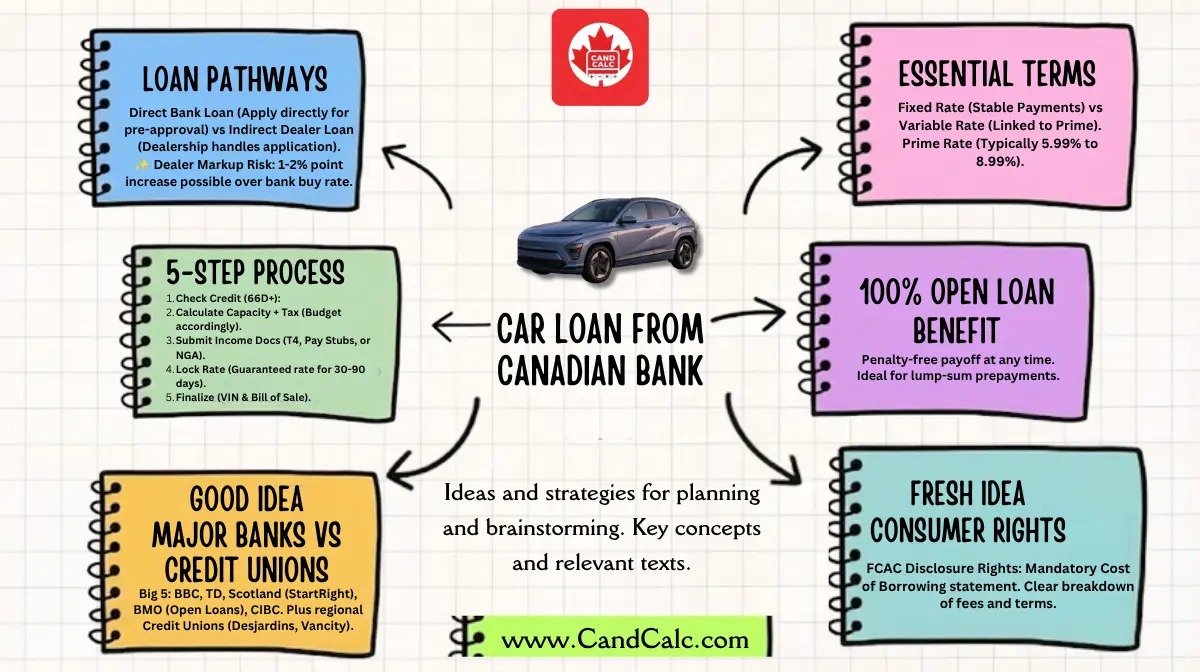
- Direct Bank Loan: You apply directly with your bank (online, over the phone, or at a local branch). The bank approves a set loan amount at a fixed or variable APR. You receive a pre-approval certificate and negotiate with the dealer as a cash buyer.
- Indirect Dealer Financing: The dealership's finance and insurance (F&I) department submits your credit application through an indirect automotive lending network (such as DealerTrack or RouteOne) to multiple financial institutions, including bank auto finance arms (e.g., TD Auto Finance, Scotiabank Automotive, RBC Dealer Finance).
While indirect financing is convenient, dealerships often mark up the bank's wholesale "buy rate" by 1% to 2% to generate dealer reserve profit. Getting a direct pre-approval prevents this markup.
2. Major Canadian Bank Auto Loan Programs
Canada’s primary financial institutions provide dedicated vehicle borrowing solutions:
| Institution | Loan Features | Typical Amortization |
|---|---|---|
| RBC Royal Bank | Fixed and variable rate options, rate discounts for existing banking clients. | 12 to 84 months (new and used). |
| TD Auto Finance | Extensive dealer partner network, flexible payment frequencies. | 24 to 84 months. |
| Scotiabank | StartRight program for Canadian newcomers, comprehensive pre-approvals. | 12 to 84 months. |
| BMO Bank of Montreal | Open loans with penalty-free prepayments, skip-a-payment options. | 12 to 84 months. |
| CIBC | Personal car loans and lines of credit options for vehicle purchases. | 12 to 72 months. |
3. Step-by-Step Guide to Applying for a Bank Car Loan
- Review Credit Profile: Verify you meet typical prime banking criteria (score 660+). If your score is building, see our advice on credit scores needed for auto financing.
- Calculate Borrowing Capacity: Use our car loan interest rate calculator to model monthly and bi-weekly payment options at current prime benchmark rates.
- Submit Pre-Approval Application: Provide income verification (T4, pay stubs, or NOA) and state your estimated purchase amount.
- Lock Your Pre-Approved Rate: Bank auto loan pre-approvals typically hold an interest rate for 30 to 90 days, protecting you against rate hikes while vehicle shopping.
- Finalize Purchase: Present your pre-approval letter to the selling dealership or private seller. The bank will issue a draft or direct electronic deposit once the bill of sale and VIN are verified.
4. Bank Auto Loan vs. Personal Line of Credit
Some Canadian borrowers wonder whether an unsecured personal Line of Credit (LOC) or Home Equity Line of Credit (HELOC) is preferable to a dedicated auto loan. While LOCs offer flexible revolving repayments, their interest rates are variable and fluctuate with the Bank of Canada policy rate. For an in-depth financial comparison, review our guide on car loans vs lines of credit.
5. Provincial Tax Integration on Bank Financed Vehicles
When a bank funds your vehicle purchase, they calculate total borrowing needs inclusive of provincial sales taxes (13% HST in Ontario, 14.975% GST/QST in Quebec, 12% in BC, and 5% GST in Alberta). Explore our Ontario car loan tax calculator to see how taxes impact your financed total.
Illustrative Example Notice: Bank interest rate ranges and program details are provided for illustrative and educational purposes. Actual rates, loan amounts, and credit approvals depend on individual financial evaluation by respective chartered institutions.
RECOMMENDED ARTICLES
Latest 6 posts

Canadian Bank vs. Credit Union Financing Comparison
While Canada's Big Five chartered banks (RBC, TD, Scotiabank, BMO, CIBC) dominate prime auto lending, Canadian credit unions and provincial caisses populaires (such as Desjardins in Quebec and Ontario, Meridian in Ontario, or Vancity in British Columbia) offer compelling alternatives. Credit unions are member-owned financial cooperatives that often maintain more flexible lending guidelines for local borrowers, recent immigrants, and self-employed professionals.
When applying for a bank car loan, your application undergoes automated credit scoring via Equifax Canada and TransUnion Canada. Banks typically offer two structures: fixed-rate installment loans with guaranteed payment stability, or variable-rate loans tied to the Bank of Canada prime rate. If you anticipate making lump-sum prepayments, confirm in writing that your loan is fully open and free of prepayment penalty fees.
Provincial Regulatory Rights for Bank Borrowers
Federally regulated financial institutions (Schedule I banks) fall under the oversight of the Financial Consumer Agency of Canada (FCAC). The FCAC enforces mandatory cost-of-borrowing regulations, requiring lenders to provide a clear, standardized disclosure statement before you sign. This statement must itemize the total interest payable over the term, any mandatory administration fees, and your rights regarding optional credit insurance products.
Interactive Bank & Financing Calculators
Compare direct bank financing terms with dealer financing using our interactive calculators:
Frequently Asked Questions
Common questions and in-depth answers.
Getting a pre-approval from a bank provides an essential benchmark. Dealerships may offer subvented promotional rates (such as 0% to 2.99% on new models) that beat bank rates, but having a bank pre-approval protects you from inflated dealer markups on standard loans.
Yes. Canadian banks finance private vehicle sales, though they typically require a formal vehicle appraisal, Carfax report, and valid safety standards certificate prior to releasing loan funds.
Yes. Personal vehicle loans from major Canadian banks are structured as open loans, allowing penalty-free lump-sum payments or complete payoff at any time.
In the current Canadian monetary environment, prime bank auto loan rates typically range between 5.99% and 8.99% APR for prime credit applicants, while subprime rates range higher.